Category: News

  • Interview: Matt Doyle, Broadway’s Future Frank Sinatra, on Conversations with Mother

    Interview: Matt Doyle, Broadway’s Future Frank Sinatra, on Conversations with Mother

    [ad_1]

    Matt Doyle is one of Broadway’s most in-demand performers, with major roles in Spring Awakening, War Horse, and Company (for which he won the Tony Award for Best Featured Actor in a Musical), while also working with symphonies and in concert performances.

    Now, he’s taken his big talent to a small space –Theatre 555 – for Matthew Lombardo’s two-character off-Broadway dramedy Conversations with Mother opposite stage and television favorite Caroline Aaron.

    Doyle recently spoke to TheaterMania about this unusual project, the biggest plus of winning the Tony Award, his desire to do Shakespeare, and the future of the long-anticipated Sinatra: The Musical.

    Matt Doyle stars in Matthew Lombardo’s Conversations with Mother off-Broadway.
    (© Carol Rosegg)

    This interview has been condensed and edited for clarity.

    How did you get involved in Conversations with Mother?
    I received an offer while I was in Maine doing My Best Friend’s Wedding last summer, and when the script popped up inbox, I was so excited to read it. I loved that it studied this mother and her gay son who have this really special and profound connection. I get that, but you have to be very vulnerable to your parents at a young age for that to happen. I came out to them at 16 and doing something so deeply personal really triggered my close friendship with my mom. I literally still tell her everything.

    How is the experience of being in a two-person play as opposed to a big musical?
    I don’t think I’ve ever been this tired; it takes so much physical and mental energy. I never really leave the stage. Originally, it felt like a lot. One day, Caroline and I looked at each other, and I said it first about how hard this is. Caroline thought it was just because she’s older. But it’s nice stretching these muscles I wasn’t prepared to use. And personally, I need to be tired, or I am a nightmare to be around. I’m the kind of person who, in real life, thinks relaxation is stressful.

    Tell me more about working with Caroline?
    We were both cast immediately, so it’s like an arranged marriage. Luckily, we hit it off on day one. She’s amazing. But her process is so different than mine; we’re totally opposite in how we work. I slowly shade in my character from an outline, while she had every color out on the table from day one. Our director, Noah Himmelstein, has been so sensitive, making sure that our ideas came together and that we always feel connected. I would play with her again any time!
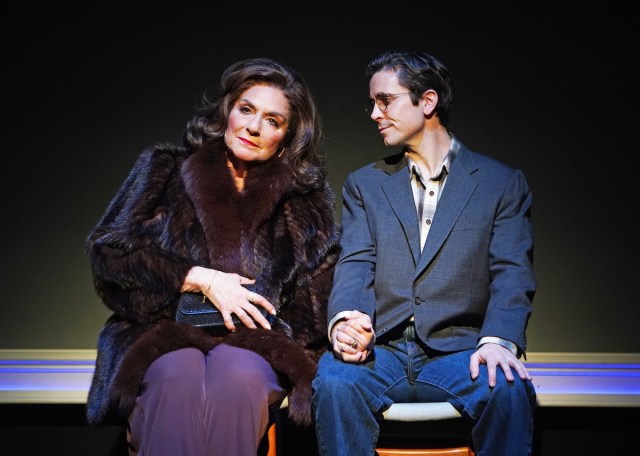
    Conversations Mother117r 3a12d0
    Caroline Aaron and Matt Doyle star in Matthew Lombardo’s Conversations with Mother off-Broadway.
    (© Carol Rosegg)

    How has your life changed the most, either professionally or personally, since winning the Tony Award?
    It has calmed me down. I’ve just dropped my shoulders, because I don’t have to prove anything. If you don’t like me in something, that’s fine; sometimes it hits, sometimes it doesn’t. I do think that actors who have stayed in theater for a long time—I came to New York when I was 19—just develop this attitude. But I am so grateful for that award in so many ways.

    Has this project ignited your spark to do more plays?
    Absolutely! My goal is, within the next 10 years, to play Benedick in a phenomenal production of Much Ado About Nothing, and, hopefully, an experimental version of Pericles, because I love the idea of taking this big heroic journey!

    I think those shows may have to wait until after you do Sinatra: The Musical, which premiered last year in England. Tell me about the show and what plans there are for its future?
    First, we’re aiming for next season, but we’re waiting for the right house on Broadway. Kathleen Marshall, our director, and her husband Scott Landis, our producer, are so smart and they know being in the wrong theatre can kill a show so easily. Otherwise, everything else is set.

    Playing Frank is a dream come true, partially because it’s so different from my other roles, and partially, because I am actually half-Italian. I love that audiences might not look at me and immediately see Frank. Vocally, I’m not impersonating him, but understanding his intonations. And we’re not changing keys. I also love the show’s dramatic elements, I am playing Frank from 19 to 38, and we explore how he got in his own way both career-wise and in his personal life, like cheating on Ava Gardner, in his earlier years. We’re very lucky our book writer, Joe DiPietro, really understands what is to be a New Jersey Italian guy.

    At the end of the day, it is a huge relief to have this life-changing show in my back pocket and I know it will happen at the right time, just like Company did after the pandemic postponed our opening.

    [ad_2]

    Source link

  • Teacher Gives Student Advanced Worksheet, But She Struggles And Now Her Parents Are Calling It Bullying » TwistedSifter

    Teacher Gives Student Advanced Worksheet, But She Struggles And Now Her Parents Are Calling It Bullying » TwistedSifter

    [ad_1]

    Source: Reddit/AITA/Pexels/Yan Krukau

    A first-year elementary teacher has been adjusting her approach to meet the needs of her advanced student, providing him with more challenging material.

    When his classmate, who is performing below grade level, asked to try his worksheet, things took an unexpected turn.

    After struggling with the assignment, the student ended up in tears, leading to upset parents.

    Check it out.

    I (23F) am a first year elementary teacher, I currently teach the 5th grade.

    It’s been a huge adjustment from college to teaching, but I enjoy it.

    One of my students (11M), (who we’ll call Warren, not using real names) is VERY advanced.

    He’s in the 99th percentile for IQ and is way above grade level in all academic areas.

    He’s autistic, but quite social, and is close friends with a group of boys he plays basketball with.

    His friends are all on grade level or slightly above, no where near him.

    Sounds like a bright student!

    Warren is a sweet kid, but if he’s not being academically stimulated, he’ll be acting like a class clown and distracting the class.

    There’s this concept in education called differentiated instruction, which is basically about meeting kids at various levels in the same classroom.

    When learning about a topic, I give Warren late high school or early college level reading materials, as that is what challenges him.

    Warren has a cousin (11F) in our class who we’ll call Mia.

    Mia is slightly below grade level, she doesn’t show any signs of autism and has different interests than Warren.

    How awesome to differentiate instruction for him.

    They don’t talk much together in class, but they don’t argue.

    The only argument they got into was when Mia made a racially insensitive comment to a classmate (who’s the only POC in my room).

    Warren tried explaining why her comment was wrong to her but she didn’t understand before I had to talk to her.

    Last Tuesday, I asked the class what they did over the break.

    Mia mentioned how their family celebrated Easter, she said Warren was acting “strange.”

    The first thing she brought up was him being atheist (his parents are religious) and how she didn’t get it, then she said he had “weird worksheets.”

    Apparently, he brought some of his homework to Easter and Mia saw it.

    She asked why his worksheets have “so many big words” compared to the ones her and her friends got.

    That’s a tricky situation.

    I tried explaining why, but I didn’t want any of the kids to feel dumb so I didn’t really give a great answer, just “it’s what he likes.”

    Mia kept asking if she could try his worksheets, because “she can know big words too.”

    I was unsure what to do as a first year, so I asked some colleagues and they said to just give her one of his worksheets.

    We were doing an English assignment on a book we read in class.

    She came crying to me when she couldn’t do it, and got virtually every answer wrong.

    I told her I wouldn’t count it and she could have her old worksheet.

    Precisely why she didn’t get that in the first place.

    The next day, I got a call from Mia’s parents, they were screaming and asked why I made her cry.

    After I explained what happened, they told me they wanted me to name the teachers that told me to give her a copy of Warren’s worksheet because they wanted to “make sure they learn a lesson.”

    I told them their names in a panic and hung up and then went to admin to explain the situation, who were sympathetic.

    Since then, both Mia and Warren’s parents have been posting on Facebook about my colleagues, calling them “bullies.” AITA?

    What seemed like a well-intentioned effort to help quickly turned into a parental nightmare.

    Reddit has mixed opinions on this one.

    On the one hand, some people think there are no winners.

    Source: Reddit/AITASource: Reddit/AITA

    And mostly that she shouldn’t have ratted out her coworkers like that.

    Although some are more understanding, since she is a first-year teacher after all.

    Source: Reddit/AITASource: Reddit/AITA

    When you try to level the playing field but end up in the teacher’s hot seat!

    Some parents are just nightmares.

    If you liked this post, you might want to read this story about a teacher who taught the school’s administration a lesson after they made a sick kid take a final exam.

    [ad_2]

    Source link

  • Gravesend baby loss art exhibition aims to ‘break down barriers’

    Gravesend baby loss art exhibition aims to ‘break down barriers’

    [ad_1]

    Patrick Barlow

    BBC News, South East

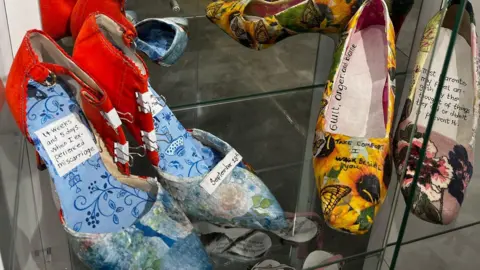
    Willow's Rainbow Box Multi-coloured shoes with labels attached to themWillow’s Rainbow Box

    An exhibit called “Walk in My Shoes” reveals some of the feelings and experiences of affected families

    An art exhibition looking at the effect of baby loss and pregnancy after loss has opened to provide a “creative outlet” for bereaved families in Kent.

    The We Remember exhibition in the St George’s Art Centre in Gravesend will feature art made in partnership with local families who have lost a baby, as well as pieces from bereaved families across the UK.

    The exhibition, which is free to visit, aims to “break down barriers” around conversations on the topic, organisers said.

    It will open for two weeks from 4-16 March.

    Amneet Graham, founder of Kent-based charity Willow’s Rainbow Box, said: “It has been a long nine months of preparation for this beautiful exhibition.

    “Our charities have enjoyed collaborating and providing a creative outlet for local bereaved families and a tribute to bereaved families nationally and internationally.

    “We hope this event encourages conversation around loss and pregnancy after loss and helps to break down barriers.”

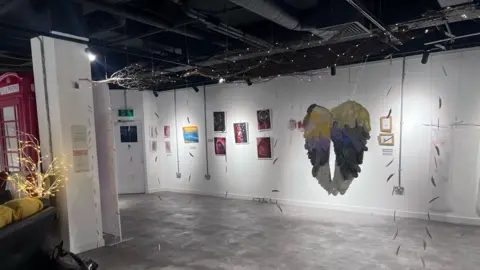
    Willow's Rainbow Box Art displayed on walls as well as a knitted set of wings hanging from the roofWillow’s Rainbow Box

    Another exhibit is made of wooden and knitted feathers with baby names on them

    Artworks in the exhibit include “Wings”, an installation made from knitted and wooden feathers with baby names written on them.

    Other works include “Silent Grief – The Forgotten Fathers”, looking at how partners are affected by baby loss.

    The exhibition is being created alongside baby loss support charities Abigail’s Footsteps and The Worst Girl Gang Ever.

    An open afternoon will also take place on 8 March where visitors can meet the team behind the exhibits.

    Half of adults in the UK said they, or someone they know, had experienced pregnancy or baby loss, according to pregnancy and baby charity Tommy’s.

    If you have been affected by the issues raised in this article, you can find information and support on the BBC Action Line pages.

    [ad_2]

    Source link

  • A moment that changed me: I was 16, gay and bullied for it. Then my father wrote to the Guardian … | Parents and parenting

    A moment that changed me: I was 16, gay and bullied for it. Then my father wrote to the Guardian … | Parents and parenting

    [ad_1]

    Growing up gay in the 90s was incredibly difficult. In 1998, I was 16 and living in east London, only out to my parents, my sister and a few friends I had made online. I’d already been the target of homophobic bullying and didn’t feel safe coming out to the rest of the world.

    I was lucky to live in a loving and supportive home. It was also a political household; my dad, in particular, was always active in expressing his beliefs and principles. Both my parents stood for things, cared about others – and they cared about me.

    At school, however, jokes about Aids were a daily occurrence and I felt deeply alone. One so-called friend told me: ‘If you turn out to be gay, I will beat it out of you.’ Like many victims of bullying, I sometimes assumed that I was the problem.

    When I came out to my parents, it was at a time when, in Britain, gay men were still discussed as a threat to the concept of family. Politicians and others openly viewed being gay as shameful, wrong or dangerous. While I knew my parents loved and supported me, I still believed I could not have as good a life as other people. I could be turned away from shops, targeted with violence, or legally sacked from my job. And even when I tried to balance this with the idea of finding someone to love, I knew that any relationship I had would not be seen as worthy of legal equality by the state or much of society. Amid all the love and support my mum showed me when I came out, she also said, sadly: “Your life will be hard.”

    It was in this context that a feature was published in the Guardian about parents who expressed their sadness, regret, disappointment or shame about having gay kids. It wasn’t malicious – it was just real people sharing their stories – but it felt like yet another example of the shame associated with people like me. And it clearly hit a nerve with my dad.

    About a week later, on 13 July 1998, my dad placed a copy of the paper in front of me and asked me to turn to the letters page. I saw an anonymous letter headed “Our gay son” and, with a lump in my throat, I read: “The reaction of the parents in your article in no way reflects that of my wife and I when our son came out to us earlier this year. Our reaction was one of pride and respect. He came out to us in an intelligent, mature and sensitive way and demonstrated an understanding of his sexuality way beyond that of many heterosexual men and women of his age … his parents have no expectations of him other than he is the person he is, and that happens to be a gay young man.”

    Alec Dick’s letter to the Guardian, July 1998. Photograph: Courtesy of Sam Dick

    I knew it was my dad who had written it and, while I already knew my parents loved and supported me, it showed that they cared deeply about other people’s children too. I felt immense pride – and also a sense of possibility. It was the first time I had seen someone close to me take action on behalf of lesbian, gay and bisexual people, and it was inspiring.

    Until that point, my number one subject at school had been geography. I took great reassurance in seeing the world as rocks and rivers, devoid of morality, social pressures and people. But, after reading the letter, my perspective quickly began to shift. I started thinking about politics, which I went on to study at university, and how I could make a difference in society.

    My dad taught me to present a the case for a better, different world. It became the driving force behind my career, kicking off two decades of campaigning for social change. In that time, I’ve tackled important and controversial social issues, from equal marriage and assisted dying to loneliness and wealth inequality.

    Today, I work as the codirector of campaigns for the NGO Global Witness, helping to uncover the systems of power and exploitation that drive the climate catastrophe. My job is to push for the real and lasting change our planet urgently needs.

    My career has not always been easy. Fighting for justice takes its toll, and success isn’t guaranteed. In my more hopeless moments, I still call my dad for advice. More than 25 years after he wrote that letter, his principled, pragmatic and compassionate approach continues to encourage me.

    My personal life has not been easy either, but it is nowhere near as hard as we all feared, not least because of my wonderful parents. Recently, my dad told me that the letter was written to me, and it just happened to be published in a newspaper. I don’t think he imagined it would change the course of my life – but he still keeps it safely in his desk drawer.

    Do you have an opinion on the issues raised in this article? If you would like to submit a response of up to 300 words by email to be considered for publication in our letters section, please click here.

    [ad_2]

    Source link

  • Don’t use our grief as a political tool

    Don’t use our grief as a political tool

    [ad_1]

    A few days ago, I heard Yair Lapid in an interview on a morning show, and I cringed. These were his words: “Smotrich doesn’t want to bring the hostages home; he wants to bring back the ‘IDF can reveal,” a term that throughout the current war was almost exclusively associated with the release of the names of fallen IDF soldiers. Even as I read those words now, I recoil at the cynical use of a phrase that, to me, is etched in blood.
    On January 16, 2024, I lost my son, Dr. Zechariah Haber—a promising scientist, a Torah scholar, a son, a brother, a husband, and a father to three young children. He fell in Gaza while serving in the reserves.

    This is not a political phrase—it is a sentence handed down to families, a life cut short, a grief without end.

    Full disclosure: Over the years, I voted for Yair Lapid’s Yesh Atid Party and at other times for centrist or center-left parties, which are now in the opposition. But I cannot accept this phrase being used as a political tool, no matter which side it comes from. Beyond the pain, I also struggle with the substance of the statement.

    Lapid is making two claims—neither of which, in my view, should ever be made. The first is that anyone who opposes the hostage deal “does not want to bring the hostages home.” It is as if there is no room for another opinion, as if it is impossible for a compassionate and caring person to look at the deal and conclude that it is dangerous and the wrong path. As if empathy and sound judgment cannot coexist. Compassion is not the exclusive property of those who support the deal, and no one has a monopoly on the desire to bring the hostages back. I don’t understand why such a terrible accusation against one’s political opponents is acceptable in Israeli discourse.

    The second is that Smotrich wants more announcements about fallen soldiers. This statement horrifies me. I do not vote for Smotrich’s party, but I do not believe that he—or anyone who believes the war must continue—loves war or feeds off death. This idea, tossed so casually into the public discourse, has turned a strategic debate into sweeping accusations, a tool for attacking an entire sector of society.

    Miriam Haber

    No one loved life more than my son Zechariah. He did not go to war because he loved death—he went because he knew he was needed. He fought so that others wouldn’t have to die. So that his children could have a better future. And when we met his comrades-in-arms after he fell, we saw that there was not an ounce of love for war among them—there was love for life, mutual responsibility, and a willingness to pay a heavy price to defend our country.

    Politicians have no right to cast doubt on them. They have no right to use our pain as a pawn in their game.

    It is okay to disagree, and we don’t have to share the same opinion. It is important to hold meaningful discussions about the heavy issues Israeli society is grappling with. But these discussions must be conducted with the basic assumption that even the person with whom I, you, or anyone else disagrees wants what is best for Israeli society.

    This column is part of “The Discourse,” a project founded by bereaved families to curb inflammatory rhetoric and restore substantive dialogue.

    [ad_2]

    Source link

  • Newport families call for supported housing for disabled children

    Newport families call for supported housing for disabled children

    [ad_1]

    Concerns about disabled children who will need somewhere to live after their parents and carers die have led to calls for homes to be built in Newport.

    Parents and young people were told solutions “will take time” at a recent meeting at Telford & Wrekin Council.

    Councillor Liz Bickford-Smith asked what plans the council had to develop supported living for adults with learning disabilities and difficulties.

    Councillor Kelly Middleton, cabinet member for public health & healthier communities, said the authority had a commitment to securing such accommodation in its local plan.

    [ad_2]

    Source link

  • Portsmouth: Nurse who went to sleep feeding two babies suspended

    Portsmouth: Nurse who went to sleep feeding two babies suspended

    [ad_1]

    The hospital told the NMC Mrs Enad also gave a father the wrong bottle of breast milk for their child and did not tell any senior staff of the error.

    It told the NMC it had started its own investigation into Mrs Enad over concerns but it had not finished by the time she resigned in June 2022.

    A panel found that she had fallen asleep while feeding the two babies and writing up patient notes on the ward on 31 July 2021.

    On 31 August 2021, she was found to have left a baby alone in an isolation cubicle, forgetting to ask a colleague to cover her absence.

    The colleague found that while Mrs Enad was away, the cubicle’s “red alarm” was triggered.

    They told the panel that suggested immediate care was required.

    [ad_2]

    Source link

  • Meghan Markle leaves pal shocked after taking dig at estranged father

    Meghan Markle leaves pal shocked after taking dig at estranged father

    [ad_1]


    Meghan Markle leaves pal shocked after making dig at estranged father

    Meghan Markle, who released her much-anticipated Netflix series, With Love, surprised her close friend by a candid admission.

    In her show, the Duchess of Sussex invites her celebrity friends and chefs to cook with them. The recipes are aesthetically pleasing and it seems to wow her guests as well.

    However, during one of the episodes in which the former Suits actress invites her pal Mindy Kaling, Meghan shared a rare detail about her childhood which appeared to be a thinly-veiled dig at her estranged father, Thomas Markle.

    Meghan shared that she was a “latchkey kid” and survived on quick-fix meals, leaving Mindy shocked over the admission.

    “I was a latchkey kid, so I grew up with a lot of fast food and TV tray meals,” Meghan told Mindy. “It feels like such a different time, but that was so normal with the microwavable kids meals.”

    Upon hearing that Meghan was left home mostly without adult supervision after school hours to have fast food dinners, Mindy responded, “People wouldn’t believe that Meghan Markle ate at Jack in the Box.”

    Meghan’s parents, Thomas Markle and Doria Ragland, got divorced when she was still quite young. While the Duchess, who is mom to Prince Archie and Princess Lilibet, did not specify which parent left her with those meals, but she only sang high praises for her mother’s cooking skills.

    Thomas has been estranged from his daughter since 2018 as she got married to Prince Harry. The two had a falling out soon after Thomas had allegedly gave comments to paparazzi without Meghan’s consent.

    [ad_2]

    Source link

  • North Wiltshire Crematorium to hold Mother’s Day event

    North Wiltshire Crematorium to hold Mother’s Day event

    [ad_1]

    The crematorium, part of the Westerleigh Group, is welcoming all to their chapel for moments of reflection and remembrance between 3pm and 6pm on Saturday, March 29th.

    Visitors can write personal messages on cards, which will be placed on a memorial tree or deposited in the ‘Letters to Loved Ones’ post box.

    Katie Capel, the crematorium manager, said: “We know, from feedback we’ve had since the memorial post box was installed, that the bereaved can take great comfort from posting messages to loved ones, and it helps them maintain a feeling of connection with them.”

    Read more: Swindon’s dentist problem as emergency appointments rolled out

    The invitation is extended to all, regardless of whether their loved one has a memorial at the site, where their funeral was held, or how long ago they passed.

    Ms Capel added: “Mother’s Day is one of those annual occasions when a loss can be felt more and we want to ensure people know that they are very welcome to take comfort in paying tribute to their loved ones at our crematorium.

    “It can equally be a particularly difficult time for mothers who are bereaved of a child, and they are also extremely welcome to visit us.”


    [ad_2]

    Source link

  • Bolton schools draw up new contract with parents to foster relations

    Bolton schools draw up new contract with parents to foster relations

    [ad_1]

    The School and Parent/Carer Partnership Agreement was devised in January and is designed to help schools and parents work together “by setting clear guidelines and expectations for appropriate behaviour, reflecting the caring ethos, values and vision of schools”.

    It was revealed this week that abuse by parents towards teachers has risen.

    This new agreement outlines what parents can expect from their child’s school, the school’s expectations of parents and carers, and the behaviours schools do not accept within our school community. 

    The policy has been developed in collaboration between schools and Bolton Primary Heads, based on their shared experiences.

    The agreement ensures that schools in the borough commit to providing a welcoming environment, showing respect, encouraging good behaviour, ensuring inclusion and listening to parent concerns, to name a few.

    READ MORE:

    New tech facilities at Bolton Muslim Girls School unveiled

    Bolton pupils opting for home education nearly doubles in 3 years

    In turn, parents are expected to engage with learning, remain respectful, support school rules, promote independent learning and address concerns calmly to reach a peaceful solution.

    The agreement also states that certain behaviours which will not be tolerated.

    These include swearing or using offensive language, causing damage to school property, making threats against anyone in the school community and posting negative comments about the school or its members on social media.

    It agreement states that breaching of the agreement can be met with a number of repercussions including seeking legal advice, removing the aggressor from the premises or calling the authorities if necessary.

    Headteacher of Claypool Primary School and NAHT representative of Bolton Amanda Hulme said: “I co-chair the Bolton Primary Heads committee, we have developed a School, Parent and Carer Partnership agreement that sets out expectations from both sides in order to tackle the issue and ensure needs are being met.

    “At the end of the day, we all want what’s best for the children.”


    [ad_2]

    Source link