A mother has gone on trial accused of kidnapping and selling her young daughter in South Africa.
Kelly Smith, whose full name is Racquel Chantel Smith, denies organising the abduction of her daughter Joshlin in February 2024 in return for a payment.
She has pleaded not guilty to the charges alongside two men – her partner, Jacquin Appollis and friend Steveno van Rhyn.
Their trial began on Monday in a sports hall in the small coastal town of Saldanha Bay, in the southwest of the country, around 72 miles (116km) north of Cape Town.
Joshlin, who was six when she disappeared, is still missing following a nationwide police hunt.
Image: Joshlin Smith was reported missing from her home in Saldanha Bay in February 2024. File pic: police handout/Reuters
Smith won sympathy across South Africa in the early days of Joshlin’s disappearance, and neighbours joined together to help police search for the child in sand dunes near the settlement of shacks and small houses where they lived.
Smith claimed she left Joshlin with Appollis on the day she went missing and had not seen her again, but police later arrested her.
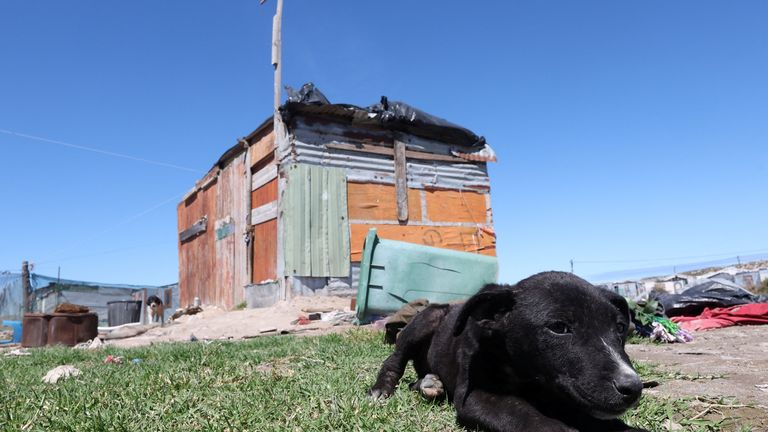
Image: The home where Joshlin lived with her mother in a suburb of Saldanha Bay. File pic: Reuters
Another woman who was arrested was not charged and is reportedly due to testify as a state witness.
In court documents, the prosecution claims Smith had been planning to sell Joshlin and her two other children since August 2023, although only Joshlin went missing.
They also alleged that Smith and Joshlin were seen getting into a white vehicle with a bag of clothes the day the girl was reported missing.

Image: Kelly Smith (wearing blue jacket standing at bench) and co-defendants Jacquen Appolis and Stevano van Rhyn at a court hearing in March 2024. File pic: Reuters
The case has provoked anger in the community, with crowds outside the sports hall chanting: “We want Joshlin back,” according to local media reports.
In March 2024, similar protests were held during a pre-trial hearing for the three defendants at the magistrates court in Vredenburg, Saldanha Bay.

Image: Protests outside the Vredenburg magistrate court during a previous hearing. File pic: Reuters
A police appeal to find Joshlin remains on the South African Police Service (SAPS) website. It reads: “Racheline Smith, 6 years disappeared on Monday morning [19 February 2024] at 9am.
“She was last seen at Middelpos Saldanha [suburb], wearing blue t-shirt and blue denim trousers, with birthmark on right arm.”
Judge Nathan Erasmus said the three defendants could face life in prison if found guilty. The trial continues.
Nine out of 10 parents will learn today that they have been allocated their first choice secondary school in Staffordshire.
Of the 8,262 (2024: 8,482) offers made for a Staffordshire secondary school at age 11, 91.9% (2024: 90.8%) per cent were for a first-choice school. National and regional average is around 85 per cent.
99 per cent have been allocated one of their top three preferred schools.
Parents were given until the end of October to apply for a secondary school. Since the closing date, the council’s admissions team has been working with schools and neighbouring authorities to ensure as many parents as possible receive a place at one of their preferred schools.
Most parents will be receiving emails and letters from today (Monday), informing them of where their child will be attending school in September.
This comes after the county council recently announced it would be spending around £50 million on new schools and expanding and refurbishing existing ones over the next year.
County Councillor Jonathan Price, Cabinet Member for Education (and SEND) said:
“Every year, more than 8,000 secondary school places are allocated in Staffordshire. Our admissions team has been working hard since the end of October to allocate these places across the county, and we have an excellent track record of being able to allocate well above the national average for first preferences.
“This is due to our forward planning in ensuring there are enough school places to meet demand, whether that’s by building new schools or expanding existing ones.
“Giving clear guidance, plus working with schools in Staffordshire and in neighbouring authorities, means we can allocate school places efficiently and, in the vast majority of cases, allocate parents one of their top three preferred schools.”
Information on how places were allocated at oversubscribed schools, schools with vacancies and the appeals process can be found through the county council’s website.
Home and Away will air the outcome of Tane Parata and Harper Matheson’s big surgery decision next week, as Dr Levi Fowler fights to save their unborn baby’s life.
In next week’s scenes, Tane and Harper’s sister Dana Matheson are nervously awaiting Harper’s surgery. Dana ends up asking Tane to go home, claiming that he’s making her feel more stressed and promising to contact him if anything happens.
Mackenzie Booth heads out of the hospital with Tane, where he admits that he feels guilty about his and Harper’s decision to go ahead with the risky surgery.
Just as Harper is about to head into surgery, she asks Levi to make her a promise – if anything goes wrong during the operation, she wants him to prioritise saving her baby’s life over her own.
Nervous Levi begins the procedure, determined to do whatever is needed to save both of his patients’ lives. But with a warning to work fast ringing in his ears, Levi is worried that he’ll end up having to make an impossible choice.
As the operation continues, under-pressure Levi takes steps that may risk the baby’s health in favour of Harper’s life. But as he remembers his promise to Harper, Levi decides to go ahead and remove the baby boy’s cyst.
Thankfully, his risk pays off and Levi is able to share with a relieved Tane and Dana that the operation has been successful. As Levi heads home, he and Mackenzie decide to enjoy a romantic night in together to celebrate.
But later that night, Harper experiences a sudden contraction. Worried Tane calls Levi, who rushes straight back to the hospital.
After Levi explains that the couple’s baby would face major risks if he were to be born so early, they decide to give Harper an injection to try to stop her contractions.
While Harper and Tane wait nervously for the drugs to work, Tane tells Harper that he’d like them to move in together so that he can help take care of her and their baby.
Finally, the doctor returns and shares good news with the pair – Harper’s contractions have stopped, and she and the baby are stable.
Delighted Harper and Tane celebrate together, feeling that they are now closer than ever after all they’ve been through. Could this pave the way for a proper future for the soon-to-be parents?
Home and Away airs these scenes on Monday, March 10, Tuesday, March 11 and Wednesday, March 12 at 1.45pm on Channel 5 and 6pm on 5STAR. First-look screenings air at 6.30pm on 5STAR and the show also streams on My5.
Selected classic episodes are available via Prime Video in the UK.
A MUM and her 10-year-old daughter have both transitioned to become “father and son”.
The pair shared their journey with their 24,000 Instagram followers, posting photos and videos about their experience.
5
Raphael (top) and Gustavo Batista (bottom) before their transitionCredit: Newsflash
5
Raphael (right) and Gustavo Batista (left) after their transitionCredit: Newsflash
5
The pair’s transition took place in Sao Paolo, BrazilCredit: Newsflash
Both Gustavo and Raphael were born with female biological characteristics, but now identify as male.
Gustavo, an actor and student, started his transition at the age of four.
He has acted in films as both transgender and cisgender characters.
Raphael, 38, stopped identifying as female last year and asked to be referred to as male.
After beginning his transition, he told local media: “Now I’m Raphael, Gustavo’s father.”
Gustavo told G1: “It wasn’t difficult to call my mother dad.”
Both Raphael and Gustavo receive free public healthcare services for their transitions in Sao Paolo, Brazil.
Raphael receives treatment at Campo Limpo Municipal Hospital.
Gustavo is treated at the Transdisciplinary Outpatient Clinic for Gender Identity and Sexual Orientation at the Institute of Psychiatry and the Pediatric Endocrinology Unit at the Children’s Institute of the Hospital das Clinicas.
Their medical care follows protocols set by Brazil‘s Unified Health System and recommendations from the Federal Council of Medicine.
‘It’s scandalous’ the way kids questioning their gender are treated by NHS, blasts Wes Streeting
Both Raphael and Gustavo said their decisions about gender transition were not influenced by the other.
Raphael told G1: “It didn’t have any influence, but he [Gustavo] gave me strength and courage to face [the transition]”
Puberty blockers were banned indefinitely for Brits under-18 who think they are transgender in December because of safety concerns.
Health Secretary Wes Streeting told MPs the independent Commission on Human Medicines had ruled they posed an “unacceptable safety risk” to children and teenagers.
Mr Streeting said: “It is a scandal that medicine was given to vulnerable young children without proof that it is safe or effective.
Mr Streeting said: “We are working with NHSEnglandto open new gender identity services so people can access the support they need.“
5
Gustavo (right) is a student and actor, and has played transgender and cisgender charactersCredit: Newsflash
5
The pair share their journey to their 24,000 Instagram followersCredit: Newsflash
At Humane World for Animals, we work to protect wild species of many kinds from trophy hunting and lethal predator control programs. Bears stand at the center of this campaign, as the targeting of black bears by trophy hunters in the U.S. has increased in recent years, and there is an ongoing fight over whether grizzly bears should maintain federal Endangered Species Act protections. Here, Wendy Keefover, senior strategist of native carnivore protection at Humane World for Animals, discusses her love for bears and the many reasons we should come together to protect these animals.
A few years ago, in springtime, my partner and I were visiting Yellowstone National Park when we ventured into a semi-remote area where the road had been closed off to vehicles. There we found a group of photographers with camera lenses as long as telescopes pointing in the distance. When we looked in that direction, we saw a mother black bear and her two playful yearling cubs.
As we watched them interact, three hours passed. We were enthralled. The rambunctious, playful cubs ran and nipped at each other and their mother at one moment, and the next they were sprinting up a tree, grabbing the bark with their claws. Then, in a moment of tenderness, they were nursing, and when they were full, they nestled into a snuggly interconnected ball. It was magical.
Those moments made me realize something: Bears are infinitely patient, devoted and vigilant mothers—traits that many people may not associate with these animals. Typically, black bear mothers wean their cubs at around 9 months, but I learned later from a park biologist that those yearling cubs were underweight and so their mother was nursing them for longer than usual—these cubs were likely about 20 months old. I already knew that bear mothers spend prolonged periods raising and nurturing young and that bear cubs learn foraging styles from their mothers. But seeing those interactions in person brought this knowledge home to me in a new way. My emotional connection to bears and to our efforts to protect them deepened after seeing how devoted this mother bear was to her family.
A UN report has called on Keir Starmer’s Labour Party government to reverse the two-child benefit limit from the DWP and a raft of Tory-era austerity measures.
The Department for Work and Pensions two-child benefit limit should be axed, says a major UN report. A UN report has called on Keir Starmer’s Labour Party government to reverse the two-child benefit limit from the DWP and a raft of Tory-era austerity measures.
The UN’s Committee on Economic, Social and Cultural Rights says ministers should now launch independent assessment of the impact of austerity measures introduced since 2010. It raises concerns that reforms have led to “severe economic hardship, increased reliance on food banks, homelessness… and stigmatisation of benefit claimants”.
In recommendations, the report says the government should “conduct an independent assessment of the cumulative impact of austerity measures introduced since 2010”. And it also says the goverment should now take “corrective measures”, including “reversing policies such as the two-child limit, the benefit cap and the five-week delay for the first Universal Credit payment”.
A person familiar with discussions said officials are “keen to mitigate the impact of the cap, if not lift it entirely”. “They have been discussing a range of options to do so, but at the moment, helping parents of under-fives seems to be one of the most likely,” the source told the paper. Another said the priority is to have child poverty falling by the next general election.
The two-child benefit cap, imposed by Tory former chancellor George Osborne, prevents parents from claiming benefits for any third or subsequent child born after April 2017.
And think tank the Resolution Foundation said the prime minister’s plan to tackle child poverty will lack credibility if it remains in place. He has previously called for the two-child benefit cap to be scrapped, but has said Labour cannot afford to abandon the policy.
Sir Keir’s child poverty taskforce is due to present a strategy in spring but the think tank’s report warned the current two-child limit is “incompatible with a credible” plan.
Traveling with a baby can feel like a logistical nightmare—diaper blowouts at 30,000 feet, trying to squeeze a stroller into a tiny European café, and the ever-looming threat of a mid-flight meltdown. But if there’s one thing I’ve learned after taking my son on ten flights before his first birthday, it’s that babies can be the ultimate icebreakers.
That’s why when I saw the now-viral TikTok of an Italian fruit vendor essentially taking over a baby’s photoshoot, I wasn’t surprised—it was just another example of how, in many cultures, babies are seen as a shared joy, not just their parents’ responsibility. The 15.2 million people who have viewed the clip in just three days clearly agree: sometimes, the best moments of parenthood come from complete strangers embracing your child like their own.
A fruit vendor, a baby, and the internet’s favorite new grandpa
The video by @kylensuttner captures what was supposed to be a quick travel photo-op at a charming Italian fruit stand. Instead, the vendor enthusiastically takes over, carefully arranging lemons around the baby, directing poses, and making sure the photos come out just right.
And while the interaction was undeniably adorable, it also highlights something deeper—the way certain cultures instinctively embrace babies as part of the community.
I know this feeling well. When I traveled with my two-month-old to France, I braced myself for side-eyes on the plane. Instead, I found myself surrounded by flight attendants and passengers who eagerly cooed over him, helped with accommodations, or just giving a knowing smile during a fussier moment. Later, when he was eight months old, he learned to crawl in Costa Rica, and it’s memories that I’ll remember much more than my hesitation of traveling with a baby.
The fruit vendor’s viral moment isn’t an anomaly—it’s a glimpse into how some cultures instinctively care for babies beyond their nuclear families.
Why some cultures instinctively embrace babies
If you’ve ever traveled to countries like Italy, Spain, or Japan, you may have noticed something different: babies aren’t just their parents’ business—they belong to the community. Anthropologists call this interdependent parenting, a caregiving model where multiple people, even strangers, feel comfortable engaging with and even holding children in public.
In Italy, babies are adored. It’s common for strangers to chat with your baby at a café, for shop owners to offer free cookies, and for grandparents to chime in with advice (solicited or not). Compare that to the U.S. or Germany, where babies are often seen as part of a contained “family unit,” and public interaction is much more reserved.
Research shows that this kind of communal caregiving has psychological benefits. Babies raised in high-touch, socially engaged environments tend to develop stronger social skills and a deeper sense of security. Parents, too, reap the rewards—when you feel supported, stress levels decrease, making parenting feel less like an isolating experience and more like a shared joy.
I’ve felt this firsthand. Traveling with my baby hasn’t always been easy (he’s had meltdowns in more than one customs line), but I’ve never once regretted bringing him along. Every time we land in a new place, I’m reminded that parenting doesn’t have to be an isolated, all-consuming experience—it can be communal, joyful, and supported by people we don’t even know yet.
For many parents, the idea of traveling with a baby feels intimidating. But here’s the secret: Babies can be your golden ticket to deeper human connection.
They break down barriers. Whether it’s a flight attendant sneaking you an extra snack or a taxi driver striking up a conversation, people are simply more open when a baby is involved.
They slow you down in the best way. Instead of rushing from sight to sight, traveling with a baby forces you to notice the little things—the way locals interact, the hidden playgrounds, the slower pace of life.
They create the best kind of travel memories. Some of my most cherished moments aren’t the big tourist sights but the unexpected kindness of strangers—like the waitress in Lisbon who rocked my son to sleep while we ate dinner.
The Italian fruit vendor’s now-legendary involvement in this family’s photoshoot is more than just a cute viral moment—it’s a reminder that, in many parts of the world, parenting isn’t meant to be done alone.
As a mom who has taken her baby across multiple countries, I’ve seen firsthand how different cultures treat children, and it’s always a lesson in warmth, patience, and communal care. My son is turning one this month, and despite every pre-trip hesitation (What if he won’t sleep? What if I forget something?), I’ve never once regretted bringing him along.
Because here’s the truth: No matter where you go, you’ll find people like that fruit vendor—ready to celebrate your baby, to support you in ways big and small, and to remind you that even in a world that often feels individualistic, parenting can still be a shared experience.
And sometimes, it just takes a few lemons to prove it.
“91 and still kicking it old school! Love you dad! Now can you finally tell me where you’re hiding the fountain of youth?! ❤️ 🎂,” wrote Jonathan Scott in the post’s caption.
Drew Scott also uploaded an Instagram post, wishing his father a “Happy Birthday,” on March 2. Drew Scott included a photo that showed him posing with his father. As for a caption, he wrote, “91 years young! Happy bday, dad. Love ya!! ❤️.”
Jim Scott Spoke About Raising His Sons in a January 2025 Interview
Jim Scott shared that he “was an instructor in Shotokan karate” and encouraged his children to practice the martial art.
“When the boys were eight, they wanted to join. I said if they started, they could not quit,” said Jim Scott during the interview. “They watched a number of classes and decided they wanted to join. Their older brother Daniel (JD) was 10 and he had joined at 8. Over the next 10 years, all three boys earned black belts and became instructors at the dojo.”
Jim Scott also gave advice about parenthood. According to the father of three, “from the beginning of their lives, parent-child relationships are a work in progress.” He also encouraged parents to “keep interacting with your kids and looking for opportunities to talk about what they’re interested in.”
“To keep their attention, it shouldn’t be a one-way conversation; that’s when their eyes glaze over. Speak respectfully, with no shouting. And always take time to listen when they want to talk. If you feel the need to have a serious discussion, lead into the conversation with something less heavy,” said Jim Scott to the publication.
Drew Scott Shared That He & His Wife Have a Similar Relationship as His Parents
In a June 2023 interview with Drew & Jonathan magazine, alongside Jonathan Scott, Drew Scott referenced that he had his first child, Parker, whom he shares with his wife Linda Phan when he was 44 years old. He noted that his father was also in his 40s when he and Jonathan Scott were born. In addition, Drew Scott mentioned that he and Phan had been together for 12 years before welcoming Parker.
“[My parents] had so many adventures before kids, whether it was overseas in Scotland or in the Rocky Mountains, which is similar to Linda and me,” said Drew Scott in the 2023 interview. “I think it can actually be a good thing to spend a lot of years truly connecting with and getting to know your partner, and that makes us stronger parents.”
Westerleigh Group’s 41 crematoria and cemeteries will be jousting memorial services around Mother’s Day (Sunday 30 March) for families to take time to remember and reflect on beloved relatives they have lost.
While each crematorium will make its own specific arrangements for Mother’s Day, all of them will be offering visitors the opportunity to take quiet moments of remembrance on site and to put messages in the memorial post boxes.
Along with memorial services, visitors can also write personalised messages and tributes on memory tags, light a commemorative candle, or decorate a pebble, which can be placed on loved ones’ memorials within the crematoria grounds or taken home.
In addition, many sites are offering the families the chance to collect a flower, or a bunch of flowers, to lay at a memorial or take home.
Debbie Smith, CEO of Westerleigh Group, said: “Our Mother’s Day invitation is open to anyone, whether or not there is a memorial to their mother or mother figure at any of our crematoria, or where their funeral took place.
“Neither does it matter if someone is recently bereaved, or suffered a loss some time ago, and it makes no difference where they live.”
She added: “Mother’s Day is one of those annual occasions when a loss can be felt more and we want to ensure people know that they are very welcome to take comfort in paying tribute to their loved ones at our crematoria.”
This national offer day (3 March), Cheshire East Council has informed thousands of parents and carers about their children’s secondary school places.
This year 95 per cent will receive an offer from their first preference school, with 98 per cent receiving an offer from one of their top three preferences.
Over 4,200 applications were submitted by parents and carers for children transitioning to secondary school in September 2025.
Councillor Carol Bulman, chair of Cheshire East Council’s children and families committee, said: “Moving up to secondary school is a monumental milestone for children and their families. Our dedicated team has worked tirelessly with schools to accommodate parental preferences, and I am delighted that the vast majority of children will be attending one of their preferred schools this September. I wish all pupils every success in their final year of primary school and as they prepare for this exciting new chapter.”
Cheshire East Council, like all councils, has a statutory duty to ensure sufficient school places for local children and young people. The council adheres to the government’s School Admissions Code, ensuring that all school places for maintained schools and academies are allocated and offered fairly and transparently.
The council has advised that when parents and carers receive their offer, they have several options:
Accept the school place – Deadline: 17 March
Join waiting lists – If a preferred school place was not offered, parents can request to be added to one or more waiting lists by 17 March.
Appeal the decision – If dissatisfied with the offer, parents can appeal before the 31 March deadline.
Parents are encouraged to accept their child’s offer even if they prefer a different school until alternative arrangements are confirmed. Additionally, parents should apply for home-to-school travel assistance before the end of April to ensure travel arrangements and passes are in place by the start of the new academic year.
Parents of pupils with an Education, Health, and Care Plan (EHCP) will receive separate confirmation of their child’s place, as they follow a slightly different timetable.