Category: News

  • Access Denied

    [ad_1]


    Access Denied

    You don’t have permission to access “http://cricket.one/entertainment/haris-rauf-becomes-father-shaheen-afridi-showers-his-love-for-pakistan-star/67cf16fc8d62744752fce6bd” on this server.

    Reference #18.5dd854b8.1741626373.3b759fe1

    https://errors.edgesuite.net/18.5dd854b8.1741626373.3b759fe1

    [ad_2]

    Source link

  • Mother calls sentence for man who raped her children an ‘absolute disgrace’

    [ad_1]

    A mother whose three children were raped by her former partner has publicly criticised the overall jail sentence imposed on him.

    Georgina Tuohey said she has already asked the Director of Public Prosecutions to appeal the case, which was the last of three separate court cases involving her children, now adults.

    Ms Tuohey was speaking outside the Court of Criminal Justice after Brendan Cornally, aged 51, of O’Brien Street, Tullamore, Co Offaly, was given an effective jail sentence of 17-and-a-half years for the rape of two of her boys and the sexual assault of her daughter.

    The court had heard how Mr Cornally developed a relationship with Ms Tuohey as she was coming out of a difficult situation and was vulnerable and, over time, exhibited a “fatherly role” to the children and “gained her trust” to look after them while she worked.

    At the Central Criminal Court on Monday, Ms Justice Caroline Biggs said experts believed it was “highly likely” that the stress around the impending court case in 2023 triggered the trauma the boy had suffered in 2018, when aged 13, putting him in a “catatonic” state.

    This boy, now a 19-year-old man still suffering catatonia, had a mild autism at the time of the abuse, which Mr Cornally was aware of, the court heard.

    Ms Biggs said that Mr Cornally was already serving a sentence of 11 years and nine months for the cases involving one of Ms Tuohey’s sons and her daughter.

    She sentenced Mr Cornally to a further 11 years for the third case after discounting four years for a guilty plea, giving an initial term of 22 years and nine months.

    But after discounting two years and nine months to reflect the law on imposing consecutive sentences (sentences that run on top of each other) and suspending two-and-a-half years to incentivise rehabilitation, the overall sentence was reduced to 17-and-a-half years.

    Ms Tuohey said this, in effect, meant a sentence of five years and nine months for the rape of her third child.

    When the judgement was handed down, Ms Tuohey, from the body of the court, called the sentence “an absolute disgrace” and said her children “have been destroyed” by Brendan Cornally.

    ‘Very disappointed’

    Outside the CCJ, Ms Tuohey said: “I am very, very disappointed. How am I supposed to come here and ask people in similar situation – and there are many – to come forward to put your case to the judge knowing your case will be heard and that the sentence will reflect the harm? 

    “Today I don’t believe that happened. However, we will appeal. I do have to feel there is a sense of justice out there. We are appealing the decision for crimes committed to my son, with special needs. He only got five-and-a-half years for harm he sustained to my children with additional needs.”

    She said the catatonic effects were severe: “He was not able to move, to eat, he became incontinent, he stopped talking, he was borderline of being tube-fed. Now, he can neither read nor write.

    “He was doing well, he held his own, he had just done the Leaving Cert 18 months ago. Now he can’t read or write. He can’t be left alone, he can’t cross the road, he can’t shower. Ever two days his memory is wiped clean because of trauma.”

    [ad_2]

    Source link

  • Meet the parents of Mark Carney, Canada’s incoming Prime Minister

    Meet the parents of Mark Carney, Canada’s incoming Prime Minister

    [ad_1]

    Credit: Instagram/@markjcarney

    Mark Carney is making history. The former central banker has won the leadership of Canada’s ruling Liberal Party and is set to succeed Justin Trudeau as the country’s next Prime Minister. His victory was decisive—securing 86% of the vote against former Finance Minister Chrystia Freeland. But while his leadership win was clear-cut, the road ahead is anything but easy.
    A political outsider in a time when experience often dominates leadership races, Carney’s reputation as a skilled crisis manager played to his advantage. His banking career, which included steering Canada through the 2008 financial crisis as the Governor of the Bank of Canada, gave him the credibility to argue that he is the right person to take on Trump’s tariffs and navigate economic uncertainty.

    2

    Credit: Instagram/@markjcarney

    “President Trump probably thinks Canada will cave in. But we are going to stand up to a bully, we’re not going to back down. We’re united, and we will retaliate,” Carney said in a recent interview, making it clear that he intends to take a firm stance in trade negotiations.
    While we await the new Prime Minister to make big changes, let us understand who are the parents of Mark Carney and if they had any influence on him.
    Mark Carney was born in Fort Smith, Northwest Territories, but grew up in Edmonton, Alberta. His parents, Bob and Verlie, were both teachers, deeply involved in education and their community. As per a report by The Catholic Register, Bob Carney was particularly active in Catholic education. He served as the executive director of the Alberta Catholic School Trustees’ Association and was a board member at Newman Theological College.
    Not just that Bob also had a little stint in politics; as per reports, he ran as a Liberal candidate in Edmonton South during the 1980 federal election, though he finished second. His work in education and politics exposed him to discussions about leadership, responsibility, and public service from an early age.
    Verlie Carney, Mark’s mother, was also an educator and played a key role in raising their four children. Mark grew up with three siblings—his older brother and sister, Seán and Brenda, and his younger brother, Brian. His upbringing sure did have an influence on him, as he is still a practicing catholic.


    [ad_2]

    Source link

  • Olivia Culpo Expecting 1st Baby – BabyNames.com

    Olivia Culpo Expecting 1st Baby – BabyNames.com

    [ad_1]

    Model and influencer Olivia Culpo is going to be a mom! The Clawfoot star and her husband Christian McCaffrey, an athlete, are expecting their first baby together. The news comes less than one year after the couple tied the knot.

    The former Miss Rhode Island took to Instagram to share images and videos from her maternity photoshoot to share her pregnancy news. “Next chapter, motherhood.” In the images, the actress wore white, with some images featuring a long, flowing white gown and others where she wore a more fitted satin white floor length dress. The videos she posted showed the model walking with the NFL player in a field. The couple didn’t any details about their little one, including their sex or anticipated due date.

    The couple’s pregnancy news comes less than one year after they tied the knot in June 2024. They said their “I do’s” in Olivia‘s home state of Rhode Island in a chapel in Watch Hill, a coastal neighborhood in Westerly, RI. At the time, the influencer shared that marriage is “the beginning of the rest of your life and it’s the union and bond of two people forever.” The Miss Universe winner shared that following their nuptials, she wanted to “start trying immediately” to have a baby. The model was first rumored to have started dating the San Francisco 49ers running back in May 2019. The couple announced they were engaged in April 2023 in a joint Instagram post.

    Congratulations to Olivia and Christian on the news of their first baby! We wish them all the best as they prepare to welcome their little one.


    Kate Fann (she/her) is the BabyNames.com celebrity blogger, as well as an established content writer, aspiring author, and social media expert. She has been featured in online publications such as Bolde, ManoByte, Medium, The Social Observer, and more. Kate has ghostwritten numerous romance novels and is currently working on publishing her own works in the Young Adult genre.

    Kate lives in East Tennessee with her husband Casey and her two sons, Quinn and Noah. When she’s not writing or scrolling Instagram, Kate can be found tasting delicious wines, playing with make-up, baking yummy treats, or hiking the beautiful Smoky Mountains.


    [ad_2]

    Source link

  • Molly Russell’s father ‘losing trust’ in minister over online safety

    Molly Russell’s father ‘losing trust’ in minister over online safety

    [ad_1]

    The father of Molly Russell said he and other bereaved parents are “losing trust” in Technology Secretary Peter Kyle over the rollout of online safety laws in the UK.

    Ian Russell said “nothing’s changed” in terms of online safety in the more than seven years since his daughter Molly chose to end her life aged 14, in 2017, after viewing harmful content on social media.

    The Online Safety Act has passed into law, and from this year will require tech platforms to follow new Ofcom-issued codes of practice to keep users safe online, particularly children, with large fines and site blockages among the penalties for those who break the rules.

    But many campaigners have criticised Ofcom’s approach to the new laws, warning it has taken too long to implement, gives tech firms too much scope to regulate themselves, and that the laws are not strong enough to prevent online harm occurring.

    Speaking to Nick Ferrari on LBC’s Online Safety Day, Mr Russell, who along with his family set up the Molly Rose Foundation in his daughter’s name after her death, said: “The Government haven’t really done anything. This is a really tough thing… Seven years down the road, I would say nothing’s changed, in my experience.

    “Nothing of significance has changed. The sort of content that Molly saw, that a coroner concluded led to the end of her life, in a more than minimal way, is still easily available online.”

    He said online safety campaigners have seen a lack of response from the Government over concerns the new laws do not go far enough to protect young people online, and as a result they are losing trust in the minister.

    “I’m losing trust with Peter Kyle, and I know all the bereaved parents that I’ve connected with are losing trust,” Mr Russell said. “Some more than me. Some are really angry.

    “We have met Peter. He was very quick to meet the bereaved families. Within the first week of forming a Government, we were in his office talking to him. It all sounded really hopeful.

    “We’re now months into government, and we’re hearing things in the papers where it doesn’t sound like he’s even considering a strengthened Online Safety Act two, which we all agree is needed, and 85% of parents we surveyed this week think is needed.

    “Yet in the press this week, Peter Kyle is saying that ‘mmm, that isn’t on my agenda’. Now, I hope that’s wrong. I hope he will clarify this and say otherwise. But at the moment, we’re really, really disappointed.”

    Mr Kyle insisted he was “committed to strengthening protections as technology evolves”.

    He said: “We are now at a critical stage, with Ofcom’s online safety laws set to take effect in the coming weeks and months.

    “I have made clear that online safety legislation must be an ongoing process, not something revisited only once a decade.

    “That is why I am committed to strengthening protections as technology evolves, ensuring we don’t repeat the mistakes of the past.”

    He added: “We must create a smarter, more adaptable regulatory system that responds to emerging threats swiftly.

    “My pledge to parents across the country is clear: I will act decisively to protect children online, now and in the future.”

    Mr Russell also said the codes of practice he had seen from Ofcom are “not robust enough” and that the regulator had “stayed safely in the middle” of the boundaries of the new rules.

    “We’ve seen the codes of practice, seen the Ofcom regulations, the way they’re enforcing that, we know that they’re not being robust enough,” he said.

    “Melanie Dawes, the chief executive of Ofcom, will tell you that they couldn’t have done anything more as a regulator.

    “Well, maybe there’s a problem with all of regulation in that case, because there’s an awful lot we believe that they could have done.”

    [ad_2]

    Source link

  • Mother’s Day Gifts for Mums Who Love a Massage

    Mother’s Day Gifts for Mums Who Love a Massage

    [ad_1]

    Mother’s Day Gifts for Mums Who Love a Massage!

    Mother’s Day is the perfect time to show your mum how much you appreciate her with a gift that helps her relax and unwind. If your mum loves a good massage or needs a little extra comfort after a long day, these massage and heat therapy gifts are just what she needs! From weighted heating pads to shiatsu massagers, here are the best gifts for mums w  ho deserve a little pampering.

    1. NIUONSIX Weighted Heating Pad for Neck and Shoulders

    Does your mum often complain about neck and shoulder pain? The NIUONSIX Weighted Heating Pad is designed to provide deep relaxation by molding to the body with its pure stone seed weight material. This extra weight enhances the soothing heat, offering a deeper, more effective experience.

    It features six heat levels (104°F to 140°F), so mum can choose the perfect temperature for her needs. The ergonomic design and 2lb weight provide targeted relief, while the automatic shut-off function ensures safe use. Whether she’s sitting at her desk, relaxing on the couch, or lying in bed, this heating pad will help melt away her stress and tension.

    Find this gift on Amazon

    Perfect for: Mums who experience neck and shoulder pain, work long hours, or simply love the feeling of warmth and comfort.

    2. MagicMakers Shiatsu Neck Massager with Heat

    If your mum enjoys a deep-tissue massage, the MagicMakers Shiatsu Neck Massager is the ultimate gift. Featuring 8 kneading massage nodes (4 large, 4 small) and 3D rotation technology, this device mimics the hands of a professional masseuse, working out knots and tension in the neck, shoulders, back, legs, and even feet!

    What makes it even better is the adjustable intensity and optional heat function, which helps soothe fatigued muscles while improving blood circulation. The bi-directional movement control mimics the natural motion of a hand massage, and it even includes a car adapter, so mum can enjoy a massage on the go!

    Find this gift on Amazon

    Perfect for: Mums who love a deep-tissue massage, experience muscle tension, or need stress relief after a long day.

    3. Electric Heating Pad for Full-Body Pain Relief

    For mums who suffer from chronic back pain, joint stiffness, or muscle aches, this Electric Heating Pad is a must-have. Heat therapy is known to improve circulation, relieve inflammation, and promote healing, making this an excellent gift for anyone who experiences discomfort.

    This king-sized heating pad (12” x 24”) covers a large area, ensuring full-body relaxation. It comes with six adjustable heat settings (ranging from 104°F to 150°F) and a customizable timer (30-120 minutes), so mum can enjoy the perfect level of warmth. She can choose between dry heat therapy or moist heat therapy for deeper muscle penetration.

    Find this gift on Amazon

    Perfect for: Mums who deal with chronic pain, arthritis, or need full-body relaxation after a long day.

    4. BYRIVER Acupressure Foot Massager Slippers

    If your mum is always on her feet, she’ll love the BYRIVER Acupressure Foot Massager Slippers. These innovative slippers feature 39 built-in massage buttons, stimulating the reflexology points on the soles of the feet. While they might feel uncomfortable at first, regular use can improve circulation, relieve lower back pain, and reduce foot fatigue.

    For beginners, wearing socks can help ease the initial discomfort. Over time, these slippers can help relieve symptoms of plantar fasciitis, arthritis, neuropathy, and even migraines by stimulating key pressure points.

    Find this gift on Amazon

    Perfect for: Mums who are always on their feet, suffer from foot pain, or love natural pain relief solutions.

    Give Mum the Gift of Relaxation This Mother’s Day!

    Whether your mum enjoys a soothing heated pad, a deep shiatsu massage, or acupressure therapy, these gifts are designed to help her relax, relieve pain, and unwind. This Mother’s Day, skip the traditional flowers and chocolates—give her the gift of self-care and comfort with a massage or heat therapy product she’ll love!

    [ad_2]

    Source link

  • I Was Like a Parent to My Younger Siblings; It Prepared Me to Be a Mom

    I Was Like a Parent to My Younger Siblings; It Prepared Me to Be a Mom

    [ad_1]

    • I’m nearly 10 years older than my younger siblings, and have always helped take care of them.
    • I’ve given them baths, fed them, advocated for them at school, and hosted them in my apartment.
    • Having this kind of relationship has made me more confident I can be a good parent.

    When I was little, I begged my mom for a younger sibling, but she swore she was done having kids. I dreamt of feeling her belly kick, going on stroller walks, and helping hush the sound of loud cries.

    Roughly five years later, my dream came true — not just once, but twice. My younger sister arrived first, followed by my younger brother just 13 months later. I was so excited that my fourth-grade teacher let me count down the days until my mom’s first round of labor on the classroom whiteboard.

    By then, my parents had been divorced for a few years. My older brother and I lived with our dad, and we didn’t have much contact with our mom. But when she told us she was having a baby, everything changed.

    I felt destined to be a big sister

    I had always known I was meant to be a big sister. Every chance I got, I was at my mom’s house, giving baths, feeding bottles, and waiting impatiently for the babies to wake from their naps so we could play outside. My mom never asked me to help; these were things I insisted on doing.

    As I got older, I understood just how vital my role as a big sister was. My siblings’ father was either incarcerated or absent in their early years, and my mom had little help. It wasn’t until they were five and six years old that he started seeing them consistently. By then, my older brother and I had stepped into the roles their father hadn’t, becoming more like parents than siblings.

    When I left for college, my responsibilities didn’t fade. My siblings spent weekends in my dorm room and, later, in my tiny apartments. I took them to the beach, museums, theater productions, and the zoo. Once, I even organized a monthlong trip for them to give my mom a break when my mom was overwhelmed by being a single parent over the summer.

    A few years earlier, she had moved away from where most of our family lived for a fresh start and to be closer to her parents. Since I was still near most of our extended family, I saw a way to help. I reached out to family members who I knew would be delighted to host my siblings and put together a calendar, including a week staying with me, full of activities. That summer was one I don’t think they’ll ever forget, one filled with swimming pools, time with their cousins, and endless love.

    All I asked of my mom was that she drive five hours to drop them off at my apartment at the start of the trip. From there, I handled the rest and returned them home safely after their summer adventure was over.


    Carly Newberg with her younger siblings out for ice cream, sitting at an outside table.

    The author is about 10 years older than her younger siblings.

    Courtesy of Carly Newberg


    Taking care of my siblings was normal for me

    I never questioned whether this kind of sibling-parenting was normal because, for me, it just was. It was second nature to always pack snacks, keep sunscreen handy, and hold hands while crossing the street.

    I protected my siblings like they were my own children because, on some days, it felt like they were.

    Now, my younger siblings are in high school, but my role in their lives hasn’t changed. They know they can call me if they need a ride, advice, or someone to vent to. I’m the person they reach out to when they have big news to share, need photos before a school dance, or want me in the crowd at their extracurricular activities.

    When I briefly worked as a substitute teacher after moving to the same city as them, I even taught in their classes. Instead of being embarrassed, they seemed proud to have me there.

    Being a big sister has meant celebrating their wins, showing up when it counts, and stepping in when they need me most. Last year, my sister was harassed and cyberbullied by a group of girls. When the cruel behavior wouldn’t stop, I marched into her school and demanded action from the principal.

    When I get nervous about becoming a parent, I realize I already have experience

    I will never stop advocating for my younger siblings — not because they need me to, but because I want to.

    I’m almost 30 now, standing on the edge of motherhood. And some days, the thought of being a mom scares me. That is, until I remember: I’ve already been a parent figure to two of the most incredible people I know.

    I’ve never doubted my mom’s strength, but I’m grateful I could step in and share the load of caregiving with her.


    [ad_2]

    Source link

  • Constance Marten and Mark Gordon retrial begins

    Constance Marten and Mark Gordon retrial begins

    [ad_1]

    Daniel Sandford & Helena Wilkinson

    News correspondent

    PA Media Police headshots of Mark Gordon and Constance Marten against a white backgroundPA Media

    A young baby girl would still be alive today if it were not for the “reckless and ultimately grossly negligent conduct” of her parents, a jury has heard.

    Constance Marten, 37, and Mark Gordon, 50, deny manslaughter by gross negligence and causing or allowing the death of a child.

    They are facing a retrial at the Old Bailey. The couple’s baby was found dead in a shopping bag covered in rubbish in 2023.

    Opening the case, prosecutor Tom Little KC said Mr Gordon and Ms Marten “put their relationship and their views of life before the life of a little baby girl”.

    “Their desire to keep their baby girl led inexorably to the death of that very baby,” he said.

    During the previous trial, Ms Marten and Mr Gordon were found guilty of concealing the birth of a child and perverting the course of justice.

    The jury heard the couple, who have been in a relationship since 2016, have four other children who were all taken into care.

    Mr Little told jurors that the couple gave birth in “secret”.

    The barrister said they then decided in the middle of winter and in “obviously dangerous weather conditions they would deprive the baby of what it needed – warmth, shelter, protection and food and ultimately safety”, the barrister said.

    Mr Little said the couple did not seek any medical assistance for the baby before, during or after birth and would carry their baby in a reusable supermarket bag on occasions.

    When the hunt by the authorities to find them intensified “so their desperation increased and so did the risks and the dangers to the baby”, the prosecutor said.

    Ms Marten appeared in the dock for the first day of her retrial. Mr Gordon was not at court.

    Judge Mark Lucraft KC told the jury that it was hoped that Mr Gordon would join them on video link, adding “the fact he is not here does not mean anything to you at all”.

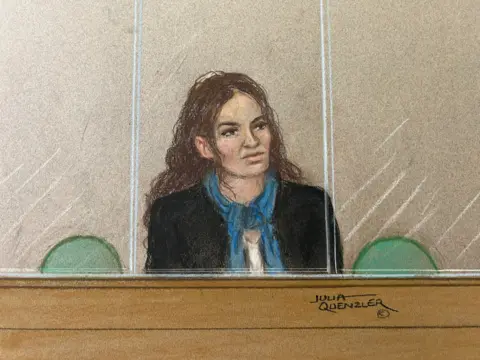
    Julia Quenzler A court sketch of Constance Marten - a woman with long brown hair, dark coat and blue scarf - sitting behind glass in the dockJulia Quenzler

    Constance Marten appeared in court for the first day of her retrial, but her co-defendant Mark Gordon did not

    The jury heard that at the end of 2022, the couple had moved around various locations in South Yorkshire, Bolton, Essex, London and the South Coast of England, and they stayed in various properties including a holiday cottage in Northumberland, a hotel in Cheshire, and another hotel in Manchester.

    The court also heard that a car the defendants used had broken down, prompting them to switch to a new car, which later caught fire on the M61 between junctions three and four in Greater Manchester.

    “They didn’t remain at the scene with their towering inferno vehicle,” said Mr Little.

    Police found a number of “burner” phones in the car, Ms Marten’s passport, a placenta wrapped in the towel, and a large amount of baby items including newborn clothing, suggesting the baby was already born by then.

    After abandoning the burning vehicle, the couple then walked in the rain along the banked wooded area beside the motorway for about 200m and were given a lift by a member of the public to a Morrisons supermarket close to the Bolton Interchange Station, where they were caught on CCTV footage shown to the jury.

    The couple first came to public attention in January 2023 when police launched a very public manhunt after evidence of a recent birth was found in a burnt-out car near Bolton.

    The couple were eventually found in Brighton on 27 February but there was no sign of the baby.

    The newborn – who they called Victoria – was found dead two days later in a shopping bag in an allotment in the Hollingbury area of Brighton.

    The retrial continues.

    [ad_2]

    Source link

  • Meghan Markle father reacts to ‘horrendously boring’ Netflix show

    Meghan Markle father reacts to ‘horrendously boring’ Netflix show

    [ad_1]

    Meghan Markle father reacts to ‘horrendously boring’ Netflix show

    Meghan Markle’s estranged father, Thomas Markle just reacted to With Love, Meghan.

    In a conversation with the Mail, he noted, “I haven’t seen the show but I’ve seen a ton of clips and I’ve read many stories. I might sit down and watch it one day but I’m not sure.

    “Cooking show are horrendously boring unless the presenter has a passion for it. You have to be authentic to hold people’s attention. When you are stuffing the turkey’s a*** it has to look like you’re having fun doing it,” he critiqued.

    “Unfortunately Meghan has never been authentic. She has to think about everything. She’s not spontaneous. Everything she says is pre-planned and rehearsed. It makes me laugh because I know all her looks and expressions,” the father to the Duchess added.

    Thomas continued, “I know when she’s faking it for the cameras. She’s trying so hard to be perfect that she tenses up every time the camera is on her.”

    “The best cooks are funny, they mess up, they are human. She just wants to be perfect. It’s sad because she’s trying so hard to stay in the limelight,” he further mentioned of Meghan Markle and what he believed her show tried to portray. 


    [ad_2]

    Source link

  • Martha Stewart, My Mother the Hoarder, and Me

    Martha Stewart, My Mother the Hoarder, and Me

    [ad_1]

    It’s still possible for me to close my eyes and remember the inside of my childhood home: the spotless, eggshell walls of a rowhouse; a Georgia O’Keeffe poppy painting above the brick fireplace, from which, at Christmas-time, hung four stockings; a black leather couch set; mirrored panels of the New York City skyline; a wooden desk and a wooden entertainment center topped with onyx panthers and a tequila-filled Olmec head. And that’s just the living room. But all of these possessions would eventually be buried under mountains of trash when my mother started hoarding. Twenty years later, when the city came to empty the house, I entered to the same walls, stained with mold, the hardwood floors eaten away by human matter. The city representative led me through like a giddy real estate agent, both our heads crowned with surgical caps, our feet with booties. Even through two masks, I could smell the house. Indescribable, so I won’t even try. The closest thing I can imagine is that it could have been my mother’s dead body, even though she was alive and sequestered miles away at my older sister’s apartment. All day she texted us a list of things to save amongst the garbage that had that morning touched the ceiling.

    My mother started hoarding when I was still inside the house. In my childhood, shuffled amongst the messy columns of Lands’ End and J. Crew catalogs in the basement, were the issues of Martha Stewart Living. When my mother locked me in the basement as punishment, I would read the playbook by which my mother and so many other immigrant mothers lived by. In the dozens of magazines, boiled down like a sauce, was the secret to being American: appearances. Because for a woman from Uruguay, who escaped a military junta of terror and the corpses of university students washed ashore, the chance to be American and to appear American were two separate hurdles. Then there was the aspiration to be perfect. Martha Stewart sold the idea that anyone could do it, and my mother, also named Martha, never let that subscription expire. Despite my parents’ meager salaries—my father a cab-driving army sergeant, my mother a secretary—my sister and I were dressed in fine clothes, name-brand, pristine and fashionable. I look back at pictures and through my own memories, and what jumps out is that my mother had taste. An American pallet with an unmistakable South American style, almost Italian in execution, including the way she cooked for us; the way Martha Stewart would have cooked for us or dressed us up for parties and school photos.

    Tied into the idea of being American is the religion of excess. My grandmother and great-aunt visited from Uruguay when I was eight, and they gasped and exclaimed to God that they’d never seen so much food in one refrigerator. When my mother was nine years old, her father died from an embolism after a plane ride from Brazil back home to Uruguay. He was thirty-three. With the primary breadwinner gone, my mother’s family was plunged into poverty. I do not know how often my mother suffered from hunger. I never really asked. I know that they’d had to eat her favorite piglet. Petunia, a name I heard often. In her early teens, she worked in a bank, and was taken hostage by robbers in the elevator. Like so many other of her stories, it trails off before it can end. She married her first husband sometime later; whether her mother married her off for financial stability or whether my mother used him to escape poverty is unclear. Like so many other of her stories, it changes depending on who she tells. She arrived in the United States in the 1980’s with nothing, lived with nothing, not even English, for so many years. So finally, when she married my Costa Rican father and they bought a home and built a life together, it doesn’t surprise me that a sudden access to resources and possessions eventually got out of control. The only way to balance out a history of nothing was with a future of everything.

    Martha Stewart sold the idea that anyone could do it.

    The April morning the city came to empty her house, my sister and I had arrived early to inspect the property, condemned three months earlier. I’d not been back to K Street for thirteen years. It was cruel how beautiful that morning was, as Spring in D.C. usually is; it’s easy to romanticize when the world is green. My sister and I scoped out points of entry for the company contracted to clean. The back door’s iron gate remained locked, the basement entrance too. In the front yard—manicured, as my mother loved to garden—we found that the front door couldn’t be opened either, because an ocean of garbage pushed back. We looked up at the second story window, smashed and cleared of glass: the entry point the fire department had used to hoist my mother out of the house when she’d fallen in January, so malnourished and dehydrated she couldn’t lift herself. We weren’t sure how she’d been eating, and there was no running water. No electricity or exits. The city officials, the fire inspector, the neighbors, my sister and me, none of us could wrap our heads around how she’d been surviving.

    The sun baked the asphalt and my shoulders by the time the cleaning company arrived with two trucks as tall as the rowhouses. My sister and I rested on a neighbor’s stoop across the thin street, the same neighbor who had contacted me in January when she saw the firemen hauling my mother into an ambulance. She poured us coffee, shared in the pain we were about to witness. It would be a completely new experience for everyone involved. Itself a trauma that still has the power to wake me up when all is dark. To have a nightmare of a beautiful morning, that’s what was so cruel about it.

    Midway through the cleaning, another lifelong neighbor arrived to greet us.

    “You don’t know this,” he said. “But your mother taught me how to grow flowers.”

    Martha Stewart’s current Instagram is itself a garden. A perfectly curated, expertly manicured collection of plants, landscapes, and Martha herself in full bloom at 83. She is a woman in total control of her universe; her health, her home, her garden. She is a litany of self-preservation techniques and instructions on how to just enjoy it all. She is everything my mother couldn’t be, even though, for her American life, it was all she’d wanted.

    When I read the copies of her magazine my mother kept, I noticed the covers featured the same but different Martha, mid-smile, in an unhindered joy and satisfaction with her life.A Martha for every season, every holiday, every social occasion and even a Martha on her downtime in an elegant home that could have been my mother’s home, cultivating a lush garden that could have been hers too. Locked in the basement, I was surrounded on all sides by boxes of Martha Stewart products or others she recommended to readers. Perhaps women like my mother could buy into that reality, even though my mother’s reality was overtaking her.

    The fire inspector, on our first phone call with him, told my sister and me that he received about seven hoarding-related cases a day. If anyone were to admit those numbers, they’d classify it as a pandemic. An infection spread through trauma, or a scarcity mindset, or unchecked consumerism. “Your mother,” he told us. “Is the worst case I’ve ever seen.”

    To have a nightmare of a beautiful morning, that’s what was so cruel about it.

    I’d not spoken to my mother since my father died in 2016, and before that, any communication was curt and unceremonious. My mother is as full of hallucinations as she is the dreams to escape her circumstances. Besides her delusions, she has a selective memory. When confronted with the child abuse and torture—Child Protective Services or the times she threatened to kill us both; the hangers, and PVC pipes, and the one time she took the weed whacker to my body—she would simply confess that she didn’t remember. A truth her brain had convinced her of, or a lie to somehow absolve that part of herself. My father and my sister had left when the hoarding got bad, when my mother beat me worse, and now, the warden of my prison couldn’t recount any of it. That was the final straw for me—to make me question my own past with a convenient amnesia sent me into a spiral. Had I imagined the bruises? The isolation and terror? No, I assert to this day. Even if no one nor their memory bore witness to your suffering doesn’t mean it didn’t happen. My memory is what stands up for younger John. If I cannot protect him, I can at least assure him that what he suffered was real.

    “There are five levels,” my sister informed me during her research into hoarding. “Mom is number five.” What I lived through in high school could have categorized that as a mere Level Four, because technically, the water still ran, and the electricity still flowed into my desktop computer. But as an adult, when the men contracted by the city cracked open the front door to my mother’s house with crowbars, what avalanched out revealed what a Level Five could really look like.

    Luckily for my sister and I, the fire inspector had told us D.C. had recently created a Hoarding Task Force. The problem was so ubiquitous the city had set aside a budget to help residents suffering from the compulsion. The cleaning would be free, he said. There was one catch: they would throw everything away. No pausing to rifle through contents to save. The men would go uninterrupted. It meant that our mother couldn’t be there; she’d surely hurl herself between them and her possessions. But she had barely recovered from her malnutrition and the fall. It wouldn’t be a problem we reassured him. “My mother’s a hoarder too,” he said. “So it’s personal.”

    Even if no one nor their memory bore witness to your suffering doesn’t mean it didn’t happen.

    That confession followed my sister and me everywhere as we attempted to save our mother from herself—social workers at the Department of Aging, nurses at George Washington Hospital where she was admitted, and even the Medicare office: it seemed everyone had a close relative who was a hoarder. It’s everywhere, we thought. Neither we nor society could escape it—that obsession with buying, with keeping up appearances; the denial that the American dream could turn on you. There were so many others who kept hoarding a secret, due to shame and misunderstanding, just as me or my sister couldn’t admit it to anyone.

    Upon our initial agreement, the city had promised us just two trucks to load away my mother’s house. After the contractor realized that the two truckloads had been from the living room alone, he ordered another pair (out of pity or because he loved his own mother), which arrived promptly and took another three hours to fill after lunch. Many of the workers couldn’t eat, and instead decided to power through and never think about my mother’s house ever again. Four o’clock came, and the city representative approached us on the stoop with a clipboard. We needed to take a tour, she said, in order to sign that the job had been done. I stopped my sister from going—she’d never seen the house in its state, had only witnessed the earlier levels of mild and moderate clutter. I’d survived years of Level Four, and Five seemed conquerable in that moment.

    I went in alone, double-masked, the fabric pungent with hand sanitizer for the smell, which lingered like an exhausted tour guide. On the eggshell walls of my childhood home grew bright black mold; the furniture, the New York City skyline, and the Georgia O’Keeffe poppy all long gone. As the men weaved in and out with full-brimmed trashcans, I marveled at how large the house felt, as if it was caught in an inhale of fresh air. The city representative spoke cheerfully, had me check off statements and agreements with a blue pen.

    “Hey,” one of the task force workers interrupted and tugged at my arm. “Come see this.”

    He led me to the basement door, that so many years before had been my refuge away from my mother, the place I had learned to love that other Martha. When he opened it, I saw a carpet of plastic soda bottles, flush with the floor of the hallway on which we stood. From the look of it, I was sure if I stepped onto the flat pile of rainbow bottles, it could have held up my body weight.

    “What do you think?” The city representative asked, leading me to the emptied dining room, the kitchen still piled high with cereal boxes and dozens of Deer Park water jugs my mother had been using instead of a bathroom.

    “It’s great,” I said. A lie, or perhaps a half-truth. After thirteen years, I was standing in the hollowed-out ghost of my childhood home, inhaling its stench and witnessing its horror for what it was: a place I’d survived, alone, without witness. A place that may exist in my nightmares, but no longer in my reality.

    My mother has since moved back to begin her hoarding again. A sickness impossible to escape. I’m still no contact with her, but sometimes I wonder if her purchases will satisfy that need to be American. To appear so. Will she be successful after all these years? Will she finally be able to replicate all those issues of Martha Stewart Living,hauled off on that beautiful April afternoon? For children of hoarders, these are unanswerable questions. So, for now, I choose the other Martha.

    When I see Martha Stewart, in her fashionable, celebrity entourage or campy makeup videos, I see a version of my mother that could have been. If only she’d poured herself into her gardening or retained her style; if only she’d kept up appearances or fought against what the world had done to her, instead of receding, letting her home rot around her. My mother had wanted to be the perfect American homemaker, and maybe, for a while, I’d wanted that for her too. I’d wanted to be raised in a house without garbage, without fear. I’d wanted my mother to be the same but different Martha, mid-smile, in an unhindered joy and satisfaction with her life.


    [ad_2]

    Source link